Thoughtful Breeding. Calm Foundations. Lifelong Connection.
.png)


Phantom, Sable, Parti & Roan Australian Cobberdogs

Colour tells us what pigment a dog can produce. Pattern helps determine where and how that pigment appears.
Understanding Colour & Pattern
A dog’s colour genetics determine the pigment it can produce — for example black or brown/chocolate. Other genes then influence where that pigment appears across the coat, whether areas remain white, and whether markings such as phantom, sable, parti or roan are expressed.
This means two Australian Cobberdogs can share the same underlying colour genetics yet look dramatically different because they express different patterns.
For example, a chocolate dog may be:
Chocolate Phantom · Chocolate Sable · Chocolate Parti · Chocolate Roan
And more than one pattern can sometimes be expressed in the same dog.

Chocolate Phantom

Chocolate Phantom Sable

Chocolate Roan
Same chocolate pigment. Different pattern expression.
Phantom
Phantom describes a distinctive pattern where lighter tan, cream or caramel markings appear in predictable places — most noticeably above the eyes, around the muzzle, on the chest and lower legs.
The darker areas of the coat are made from eumelanin, while the lighter phantom points are phaeomelanin.
Whether those darker areas appear black or chocolate depends on the dog’s underlying colour genetics, which is why we can have both black phantom and chocolate phantom Australian Cobberdogs.

Sable
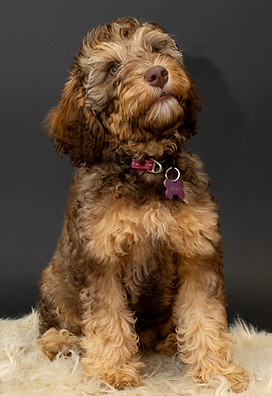
Sable describes a pattern where the coat is predominantly red, gold or caramel-toned, with darker eumelanin shading or tipping through some of the hairs. This darker pigment is often most noticeable around the ears, face, back and tail.
Sable can be particularly striking in puppies, which may be born with quite obvious dark tipping. As the adult coat develops, much of that darker shading can soften or disappear, meaning a sable puppy may look considerably lighter as an adult.
Parti
Parti describes a pattern where larger areas of white appear alongside the dog’s underlying colour. The coloured patches may be black, chocolate, caramel, red or another permitted colour, depending on the dog’s base pigment genetics.
The amount and placement of white can vary considerably from dog to dog. Some dogs have relatively modest white markings, while others may have much more extensive white across the body. In many breeds, this type of white spotting is associated with variation in the MITF gene, commonly discussed as the S locus.

Roan
Roan describes a pattern where coloured hairs develop through areas of the coat that would otherwise appear white, creating a blended, mottled or speckled effect.
Unlike a solid coloured patch, roaning is produced by an intermingling of pigmented and unpigmented hairs.
Puppies may therefore appear to have much clearer white areas when very young, with the roan pattern becoming increasingly visible as the coat develops.

Pattern Is the Finishing Touch
Phantom, sable, parti and roan can create beautiful and sometimes dramatic differences in appearance, and we enjoy understanding the genetics behind them.
But pattern is never where a Lovelocks breeding decision begins.
We first look for temperament, health, sound structure, human connection and trainability. Only once those qualities are in place do colour and pattern become part of the picture.
We choose the dog first. Pattern comes afterwards.